
Stopping Time
On delayed gratification and other economic theories

The other day, my eldest son told me that if his plan A for “what do you want to be when you grow up?” doesn’t work out, he already has a plan B. Plan B, he said, “is to be a businessman.”
I put on my best poker face as dark thoughts and unedifying feelings piled up in my head, and I made a titanic effort not to burst out laughing or scream in terror.
“Businessman?” I asked. “What does that involve?”
“Well, making deals, Mum,” he said deals in English, half exasperated by my ignorance, because apparently “deals” are more important than “tratos”, which clearly sounds a bit mafia-like or, worse, southern European.
Horror got the better of me and I blurted out, “Couldn’t you be something useful like a firefighter or a farmer?” As if the alliteration would make the alternatives more alluring. Thank goodness E arrived with an urgent need and I was able to drop the subject there.
I was left concerned about the kind of conversations children have in the school playground these days, because we don’t listen to the news at home and I could swear there’s no Trump and his “art of the deal” game on Roblox, but I could be wrong. And I was left thinking about my 11-year-old son who doesn’t dream of fixing the world, but of selling it. I think I’m going to increase his hours with the guitar teacher, so that his plan A (to be a rock star) has a better chance of working out.
I am overcome by the feeling that my children are growing up too fast, which is perhaps why I still allow E to come into our bed in the middle of the night, despite the fact that he crosses the hallway like a stampede of buffalo, sleeps diagonally, and weighs 22 kilos, meaning that one well-aimed nocturnal headbutt could cause a concussion.
The other day, I heard P, who is still torn between being a child and a teenager, asking C for some dinosaurs to play with while he was in the bath, and C brought him the whole dinosaur collection while muttering, “That’s right, my love, be a child a little longer, because I’m not ready for what’s coming.” It made me laugh and cry at the same time. What a dilemma it is to be a parent, whose job boils down to preparing our children to be exactly what we least want them to be: adults.
A few weeks ago, E asked about the fate of his paternal grandfather, who died more than 20 years ago but whom C keeps so present that I feel my children know him very well, because C talks about him so much. E (5 years old) asked where his nonno was, so present and yet so elusive. I, who don’t beat around the bush when it comes to important things, told him:
“He died.”
He looked at me curiously and, of course, followed up with:
“And abuelito?”
“Abuelito is alive, but he will also die.”
Perhaps that sounds like excessive information, but I am summarising the conversation to the bare minimum and I assure you that it was necessary to explain to him that our days are numbered. What followed was the awakening of childhood, live. His sweet little face folded into a grimace of sadness:
“And you, Mummy?”
“Me too, and you, and everyone when we get old.”
This was followed by a howl of pain, “Noooooooo! I don’t want to get old,” which, thank goodness, was calmed with a hug and a “There’s still a long time before that happens,” ‘a long time’ being an eternity for a 5-year-old.
Here I had to allow myself the luxury of making my son believe that we all die of old age, because explaining to him that there are people who don’t reach an appropriate age to kick the bucket bordered on cruelty. But it’s true, there are people who don’t reach old age, and one wonders if she will be the one with the losing ticket.
Working as an oncologist, one is more likely to ask oneself that question, which is why doctors are so good at compartmentalising. I swear that for 20 years I have been convinced that cancer is something that happens to other people, but no. It’s not that I have cancer, but I’ve just spent a month in the ward with patients who are very ill and hearing relatives say such sad things as “Someone robbed us of 20 years of being together.” I go home thinking I’m going to book an outrageous holiday this summer, because saving for old age is all very sensible, but it may not do me any good.
Of course, one tries to rack up points so that the roulette ball lands on the ‘senile’ square and one gets to enjoy what one has saved. Generally speaking, by following certain guidelines that do not need to involve spending a fortune on dietary supplements and infrared baths, in today’s Western world the odds of reaching old age are in our favour. However, the guidelines must be followed. That’s why doctors don’t go around shouting “The dead to the hole and the living to the pastries!”1 and our discourse takes a more boring turn: “Just the right amount of pastries, because obesity and type 2 diabetes are the great epidemics of the 21st century.”
You may be wondering what has gotten into me. I’ll tell you: hunger has gotten into me, and at 46 years old, with my perimenopausal hormones hacking my hypothalamus, all I want to do is eat everything, all the time. But I’m lying, I don’t want to eat EVERYTHING, I want a jamón sandwich at 10 in the morning after having had a French omelette with two eggs and half an avocado and Greek yoghurt with walnuts for breakfast. I’m raiding my children’s sweets jar, and they’re wondering how it can be that it’s shrinking at such a disproportionate rate from Saturday to Saturday, because the poor things believe that their mother walks the talk... I have yet to crave spinach.
Thinking about this as I got out of the shower the other day, glancing sideways at my flesh in the mirror, I remembered something I read in my health economics course about making the wrong choices when it comes to our own health. It’s strange that we want to live forever, but we tend to make it difficult for ourselves. That saying, “what doesn’t kill you makes you fat”, which we repeat with laughter as we consume one or the other which we have the bad habit of liking more than what is good for us. That’s why we toast with champagne to the health of others and why celebrations are done with cakes, not broccoli. What a strange condemnation ours is, to want opposite things – eternity and bacchanalia.
Of course, health authorities find themselves in the position of needing to convince people not to consume too much of what is bad for them, which will end up costing us all dearly. But humans have a strange way of thinking that seems to follow the line of ‘if they tell me it’s bad, it must be really good’.
Something like that happened to me when I was 20 and met a very handsome guy in Paris, who lived in Montmartre no less, rolled cigarettes with a skill that I would include in the cultural heritage of humanity, and claimed to be a writer (I never saw him write anything, but that’s not important). Hence, I obviously dreamed of being Malena. The fact is that the businessmen of the world have turned marketing into an art form and we all want to be Malena.
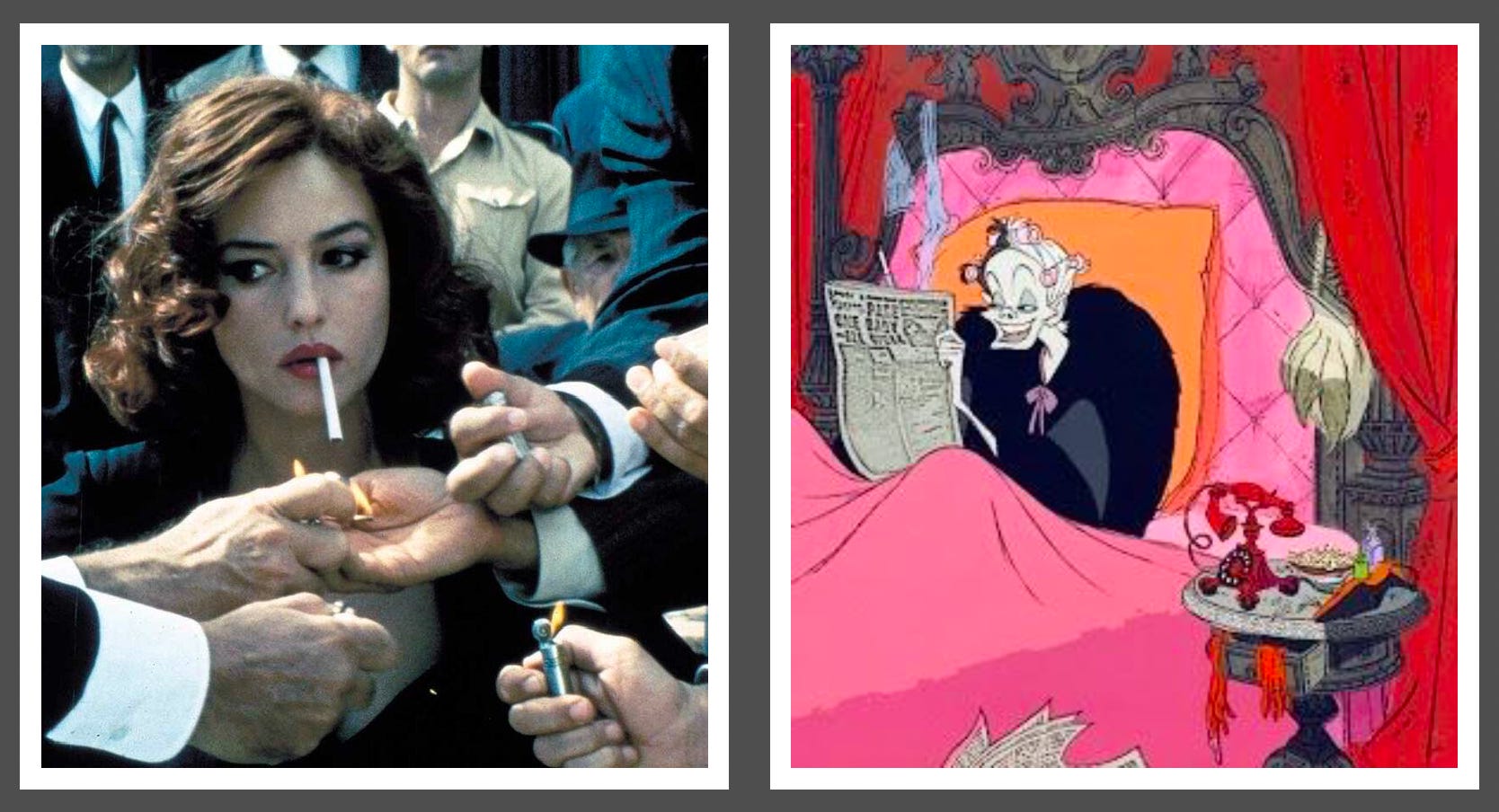
Apparently, there is an economic theory about the consumption of harmful or even addictive products that explains that consumers make rational choices by balancing immediate benefits and future consequences. If the immediate benefits outweigh the future consequences, or if the poor user is unable to assign the appropriate weight to an unhealthy future, things may end badly. Reading about this reminded me of an internist I met in Boston who was researching addiction. I told him that I didn’t try cocaine because I was sure I would immediately become cocaine addict, to which he replied that the ability to project oneself into the future is the number one characteristic of people who do not have addictive tendencies. In other words, you have to have imagination to understand that it’s not a good idea to finish the whole packet of Oreos in one sitting, week after week. Imagination to see yourself with a triple bypass and ordering a side of insulin in restaurants. Imagination to make that vision scary.
Stringing together thoughts on economic theory and cancer incidence, I applied moisturiser and thought about the concept of “delayed gratification” and how to achieve Pareto efficiency in this regard so as not to drop dead without having enjoyed life or be buried with an iron lung.
The answer came to me as I dried my hair: no idea.

This is a Spanish saying that rhymes “el muerto al hoyo y el vivo al bollo”
I can’t imagine how much more intense and un-abstract dealing with mortality must be, doing what you do, and what inner turbulence it must cause. Made me think of the great, most humane writers, who were doctors (Chekhov, Bulgakov).
Modernity seems to have a disproportionately calculated sterile focus, like living in bubblewrap. I was out with a bunch of barely 30 yrs old last Friday and it was bizarre how cautious they already are, and how bland their teenager years were, when it got to that. No vida loca at all. Seemed like a big mentality shift - the elimination of risk, life as a portfolio to be preserved rather than an experience to be spent, all living in the future and never in the present.
Eternity without a touch of bacchanalia seems rather boring, if not a waste.
It’s really touching how your husband keeps the grandfather alive, maybe the best legacy one can have!
The cocaine bit resonated - had a similar feeling about hardcore hallucinogens, because I’d be the kind of person who would tear her skin off, with a snowball imagination even sober.
Not all businessmen sell. some are accountants. I enjoy your honesty.